Rethinking time-to-value in B2B SaaS onboarding
brand

role
Product
Design system
Data model
AI orchestration
Build & deploy
tools
Cursor, Claude Code
Next.js 16
React 19, Tailwind v4
Prisma & Supabase
Claude API
Resend
Playwright
Vercel
summary
Vector helps vendors cut time-to-value and stop first-90-day churn. It's a shared vendor/customer workspace with an AI layer that does the tedious work: drafting follow-ups, turning meeting transcripts into tasks, and surfacing risk before an onboarding goes sideways.
setting the stage
I noticed a problem: procured tools promise value, then lose momentum at onboarding. Vendor-customer context gets lost in a sea of meetings and time-to-value slips. So I scoped the product and shipped it solo, from the data model and AI pipeline to the front end and deploys.
My role

product >
I conducted market research, set the ICP, scoped the product and made the feature bets.

design system >
I created Vector's visual identity and a single source of truth for the design system.

architecture & build >
Agents wrote the syntax. I researched and approved every architecture and build call.

AI orchestration >
I designed the AI layer, from grounded prompts to streaming tool use and observability.
Problem space
Follow-up falls
through the cracks
Onboarding a new B2B tool is follow-through. Most of it is agreed on calls and action points often get muddled and lost. The teams who feel this most are start-ups and scale ups that are stuck between two bad options.
too heavy
Enterprise tools
Rocketlane and GuideCX are built for large implementation teams, they are expensive, and take months to roll out.
too manual
Hacked PM tool
Teams hack onboarding into Notion, Linear or Asana. Nothing tracks health, the customer has no real view, and the follow-up work is lost.
Most onboarding tools optimise for the vendor's internal project management. I optimised for the shared experience, and let AI handle the follow-up that usually falls through the cracks.
/shared board
The product
Shared view and AI
that keeps work on track
Vendor board
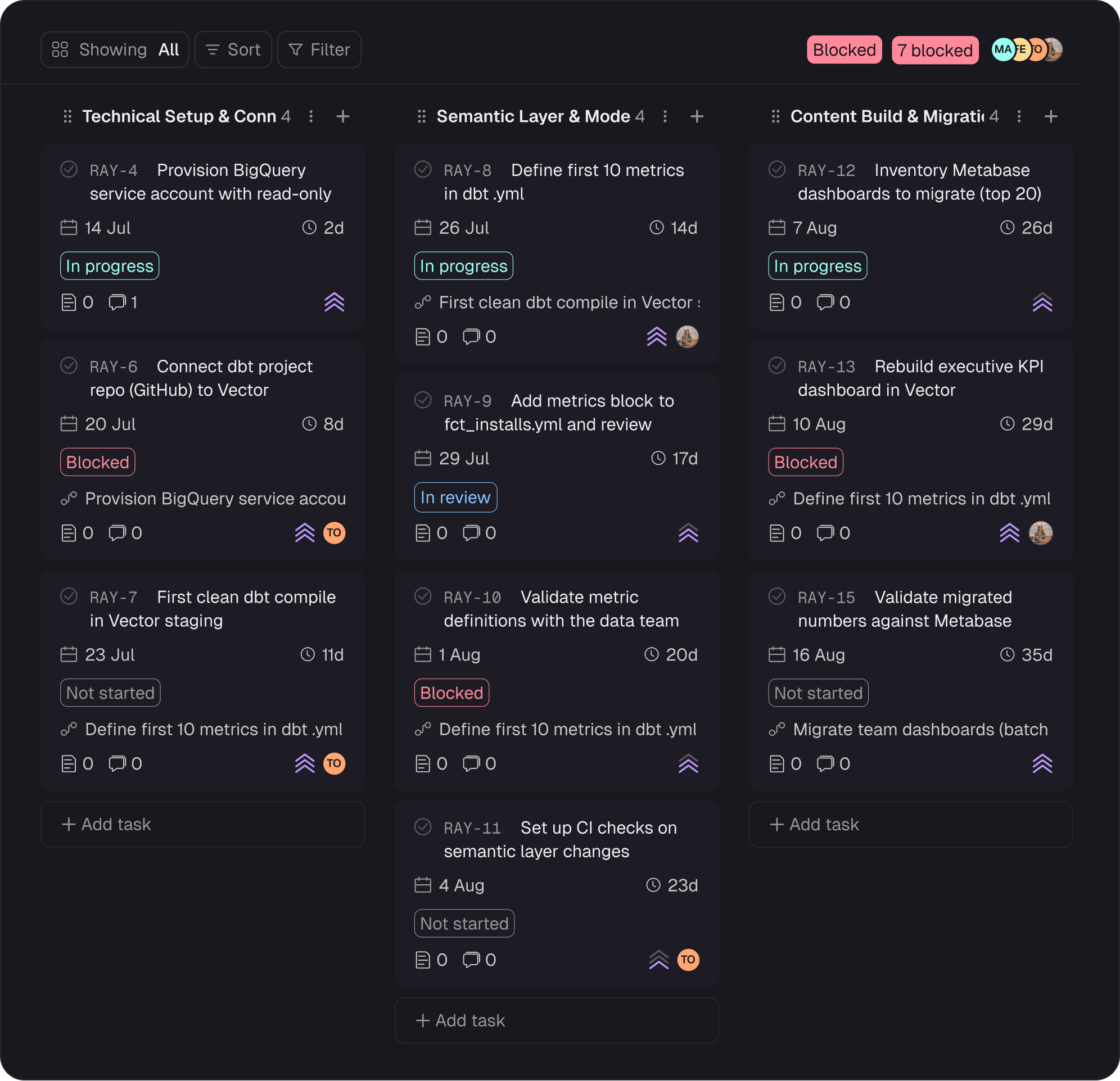
Every onboarding runs as a Kanban board. I made the columns phases instead of statuses, so the board reads as the journey from kickoff to go-live, and progress lives on the task as a tag.
Vendor and customer work from the same board. Both see the full plan, and the customer's portal focuses on their own tasks.
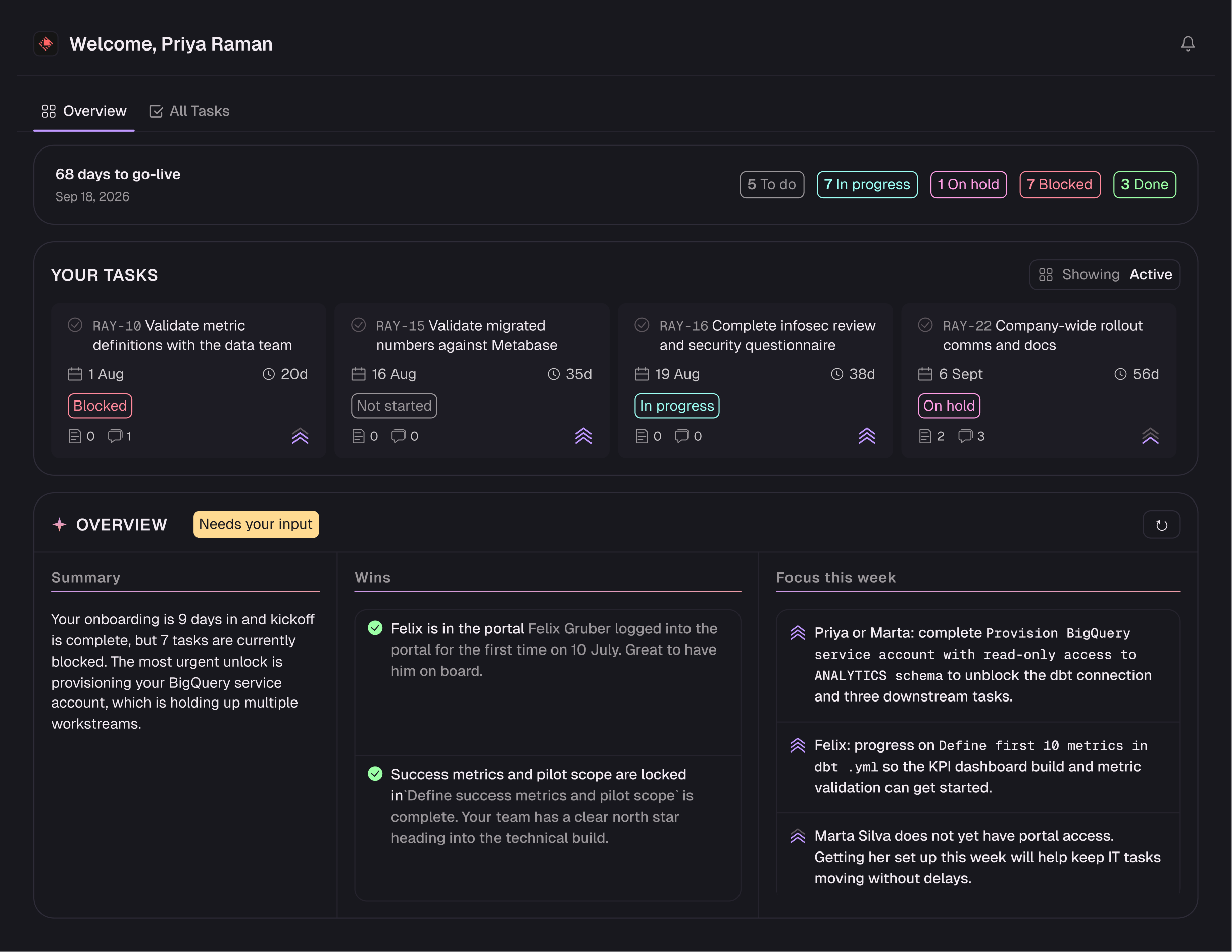
The customer clicks a magic link and lands straight on their tasks. No account, no password, no training. Every visit is tracked, so the vendor knows the moment they go quiet.
Customer portal
The customer sees their progress and what needs their attention this week. The portal highlights their own tasks, so their work cuts through the noise.
Notifications centre
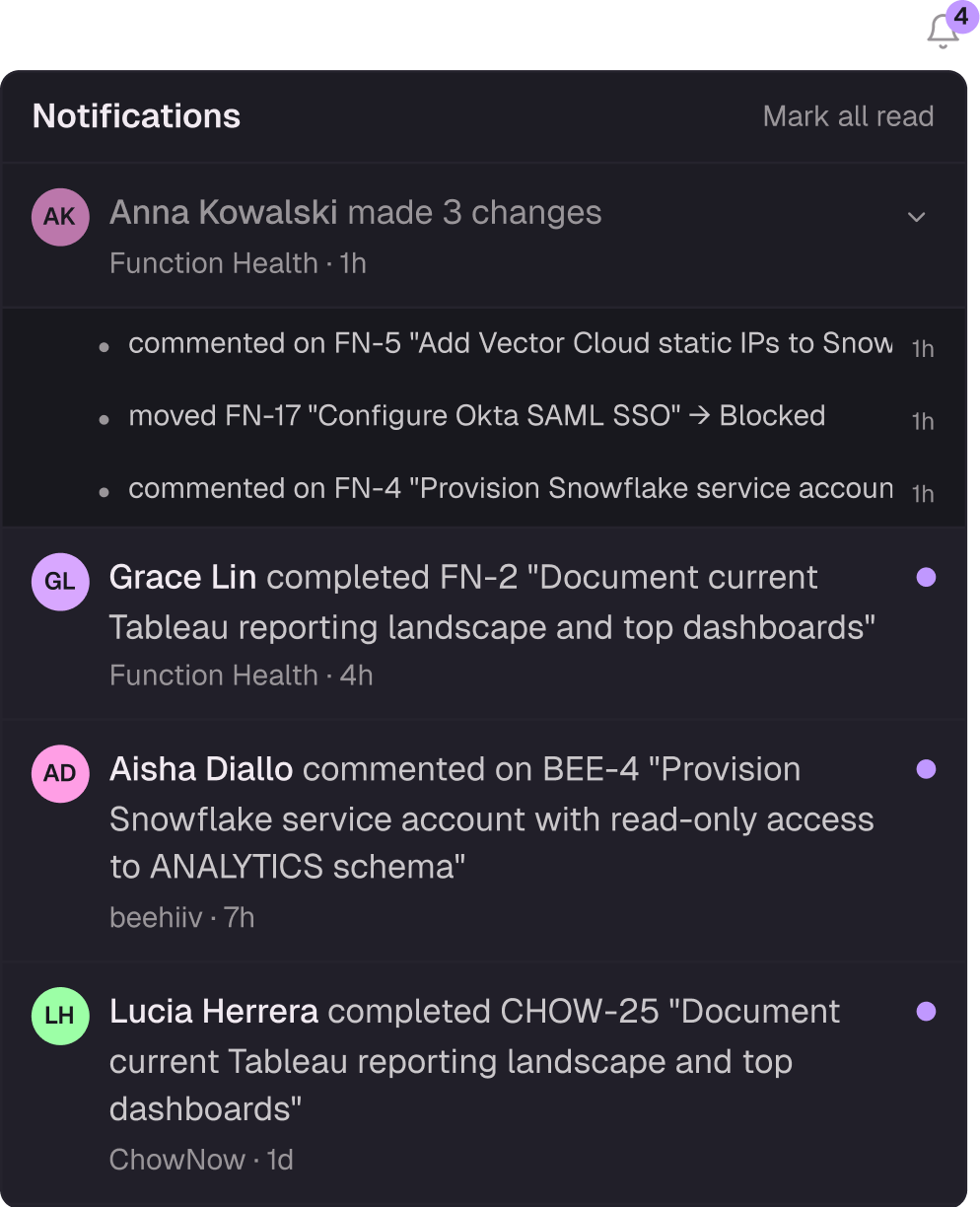
Everything the customer does flows back. A completed task, a new comment and a first portal visit each land in the vendor's notification centre, and one person's changes collapse into a single entry to keep the noise down.
Email is saved for what needs the most visibility. Portal invites, task assignments and comment alerts go out through Resend, so they reach the customer where they already work.
notification routing / lib/db.js
/predictive health
Predictive health
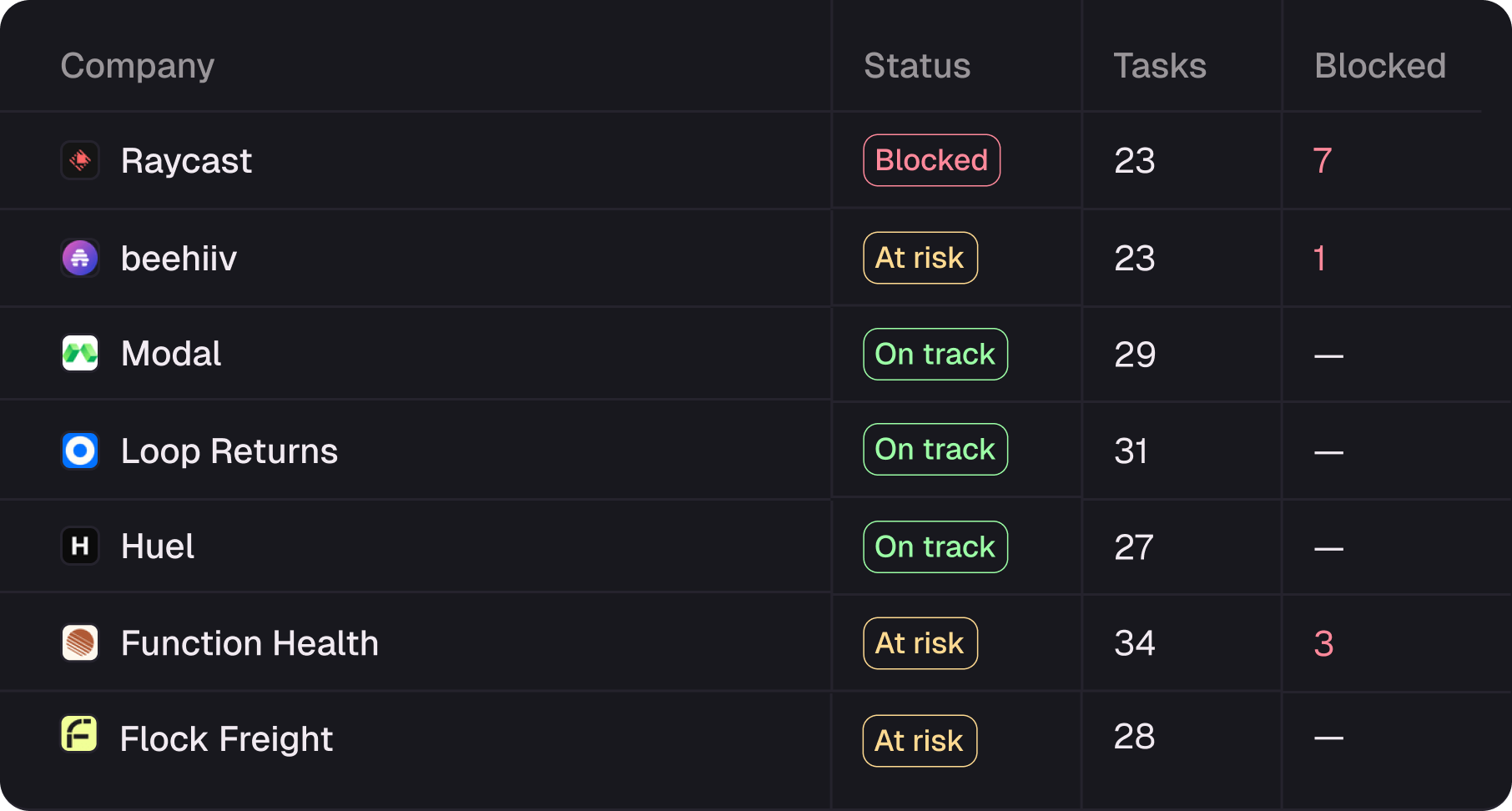
Every onboarding is scored On track, At risk or Blocked. The triggers are all real task data, blocked or overdue work, a pace that overruns the go-live date, a third of the tasks stuck. I kept AI out of the scoring on purpose. It's deterministic JavaScript, so the same input always gives the same answer.
lib/health.js
// no model in the loop, only task data
const BLOCKED_THRESHOLD = 0.3;

if (blockedPct >= BLOCKED_THRESHOLD) {
  status = "Blocked";
  reasons.push(
    `${blockedCount} of ${total} tasks blocked`);
}
// every flag carries its evidence
return { status, reasons };
Every flag arrives with its evidence. 3 of 9 tasks blocked, 8 tasks overdue, customer dark for 64 days. When you can see why the flag was raised, you can act on it.
/ai admin
AI overview
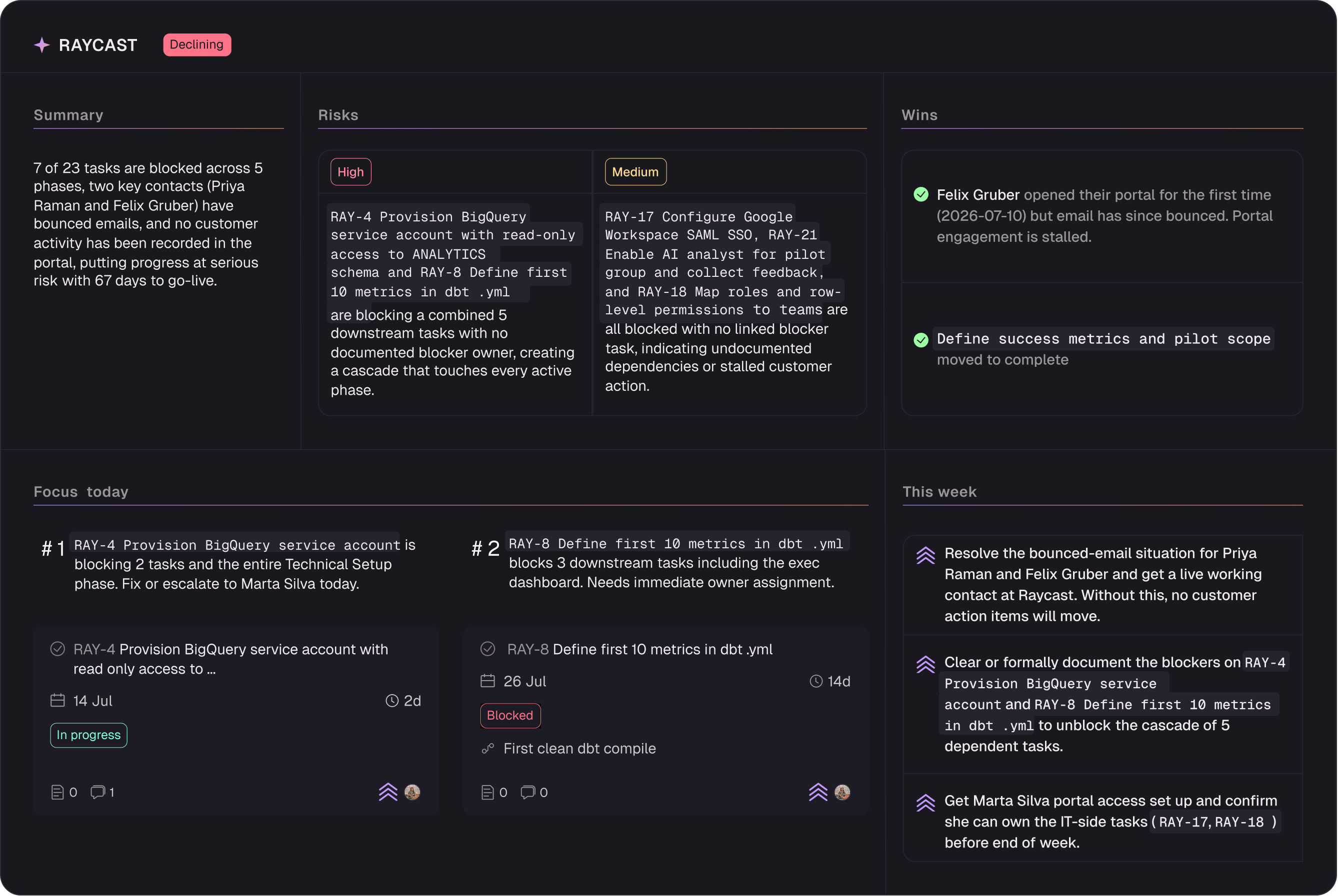
Two views, because different roles need different depth and nobody needs everything at once.
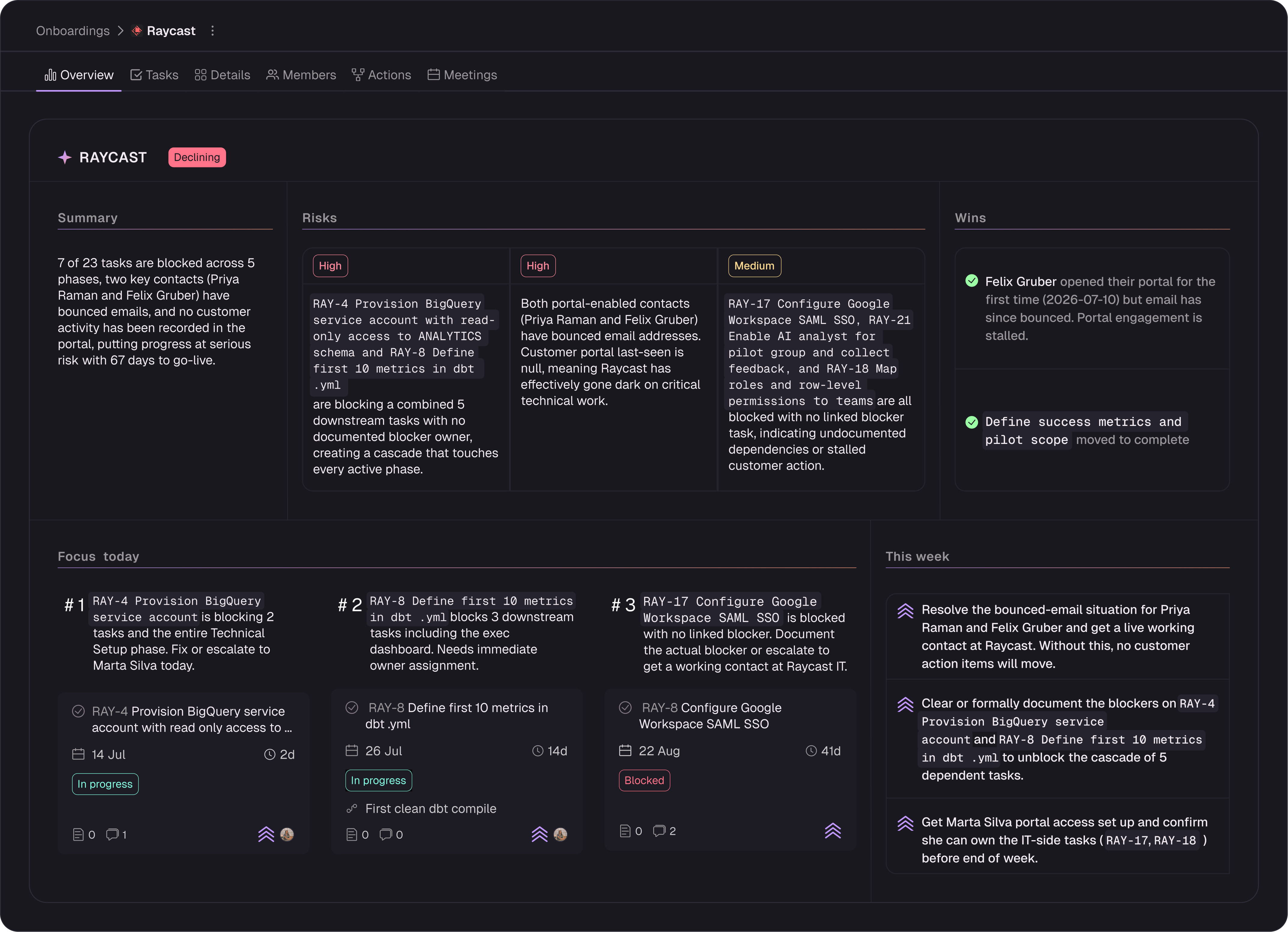
The portfolio high level view shows which onboardings need attention. Inside an onboarding it gets granular, with focus for today, this week, risks and wins. Every claim is anchored to a real task id.
Turning meetings into tasks
What was agreed on a call is the easiest thing to lose in an onboarding, so Vector writes it up instead.
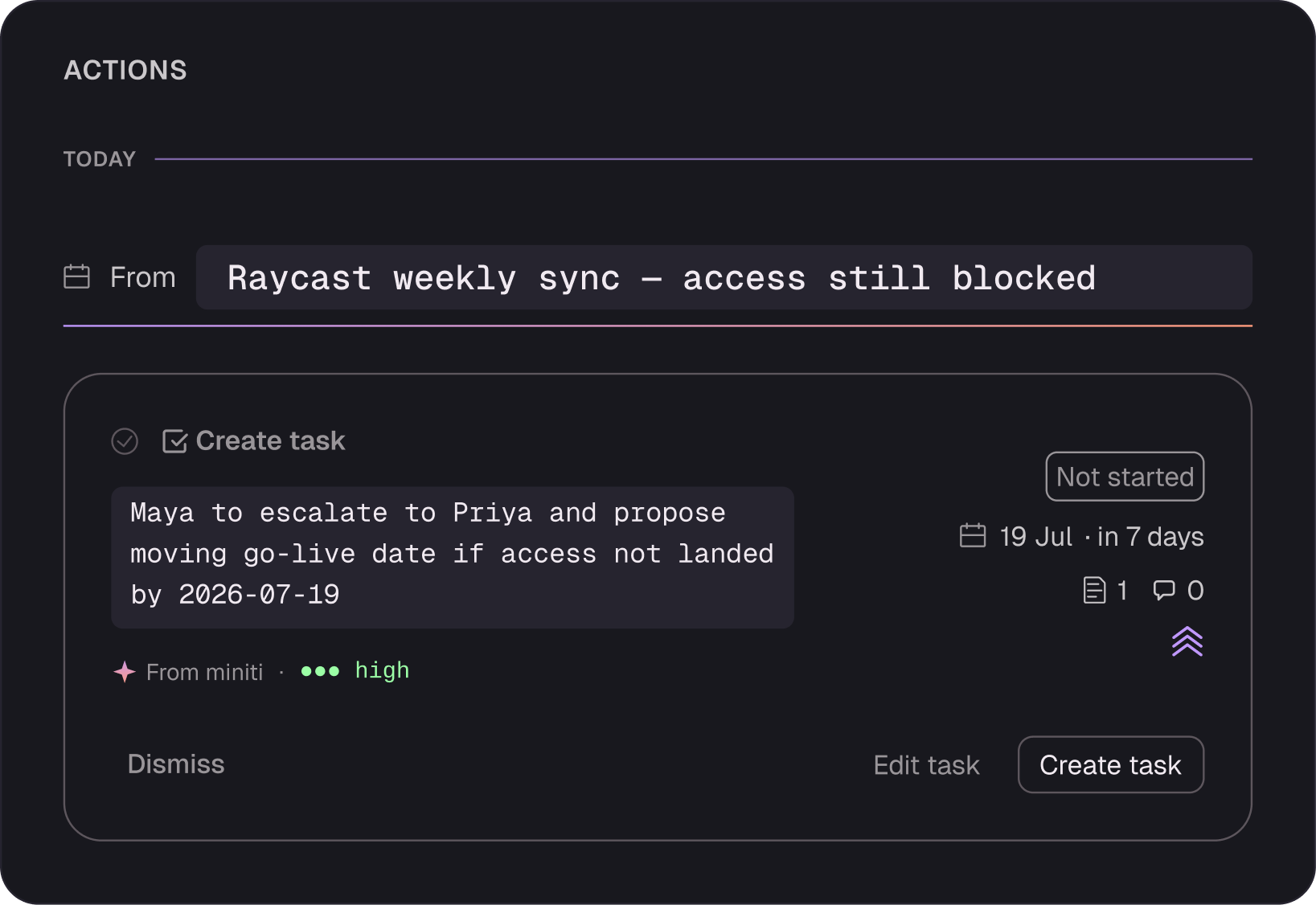
I integrated an AI notetaker, Miniti. When a call ends it fires a webhook with the transcript, and a tool-use orchestrator reads it and drafts task creations, status changes and reassignments. It reads the board first, so work you already track becomes an update to the existing task instead of a duplicate.
miniti → vector
call ends
pass 1 / extraction
pass 2 / orchestrator
review queue
Automated follow-ups
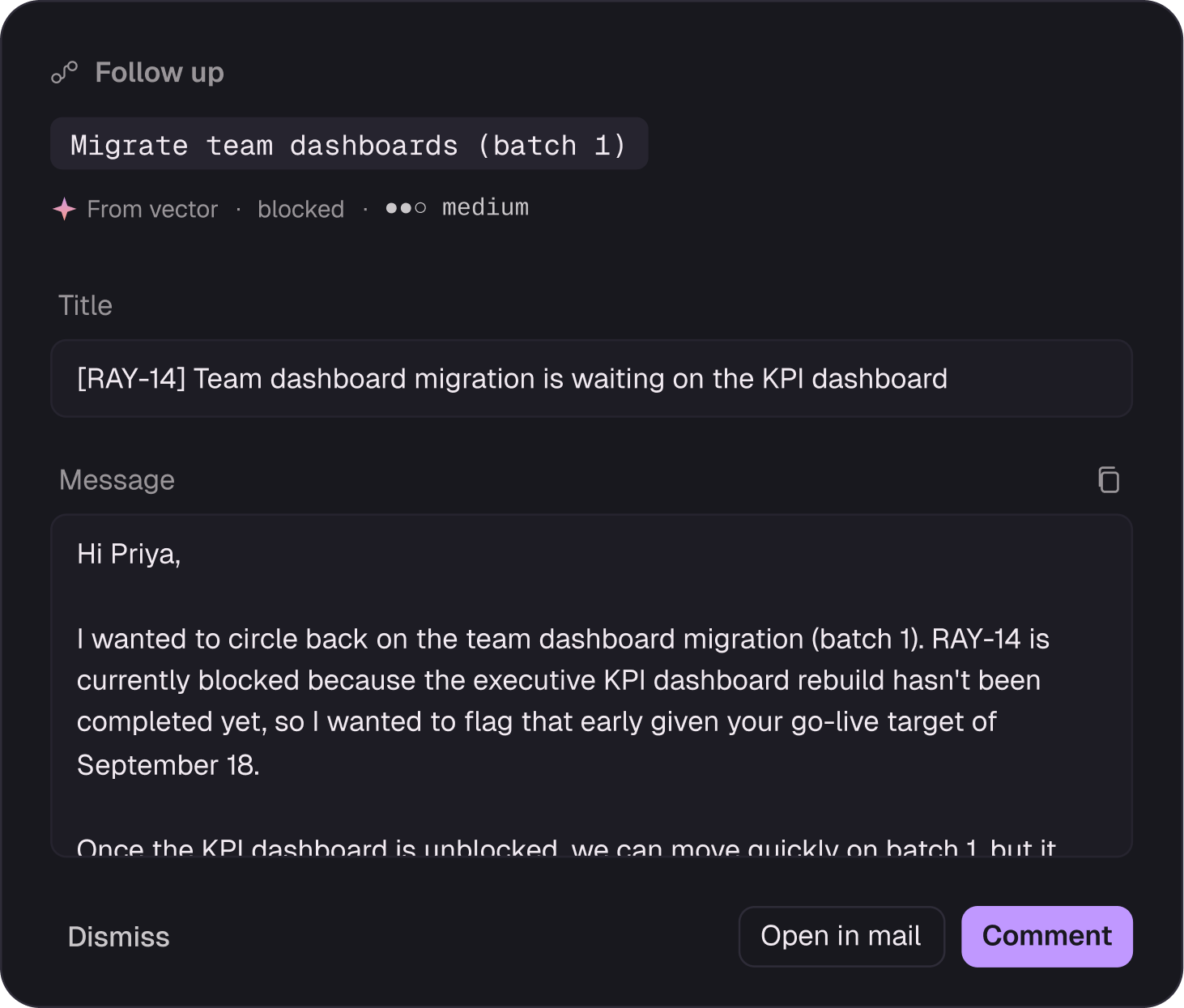
A weekly scanner on Vercel Cron walks every active onboarding and flags any task blocked or more than five days overdue. Each flag becomes a drafted email that only the task's owner sees, one approval away from sending.
A task with no owner gets no follow-up. I chose clear responsibility over copying everyone in, and kept one plain tone for now. Adapting the writing to each user's voice is on the roadmap.
lib/ai/scan-stale.js
// vercel cron: Mondays 08:00, "0 8 * * 1"
const stale = tasks
  .map((t) => withStaleness(t, today))
  .filter((t) => t.staleness !== null)
  // no owner, no follow-up
  .filter((t) => t.ownerId != null)
I gave the AI a review queue instead of write access to the board. It drafts, and the user decides whether to approve, edit or reject any task or follow-up.
The matching
Whose meeting was this?
signal #01
Attendee domains
When a meeting has an invite list, a matching customer email domain is the strongest signal.
signal #02
Contact emails
Failing that, each attendee's email is looked up against every onboarding's contacts.
signal #03
The title
The title is scanned for the significant words of a company name e.g. “Raycast weekly sync”.
signal #04
The transcript
The last resort: summary, topics, notes and transcript are searched for a customer mention.
no signal
Needs your input
Zero or more than one candidate and the meeting lands in “to assign the inbox”.
The AI layer
Grounded, efficient
and observable
I designed the AI overview to keep the model away from hallucinated facts. Plain JavaScript computes the hard signals (overdue counts, velocity, customer engagement) from a small snapshot of the board. The model owns the narrative, and the guardrails stop it from inventing.
// Layer 1: deterministic code builds a snapshot.
// Claude reads it. It never does the arithmetic.
{
  "onboarding": { "company": "Initech",
                  "daysToTargetGoLive": -121 },
  "facts": {
    "totalTasks": 9,
    "tasksDone": 1,
    "tasksOverdue": [
      { "taskId": "IN-4", "daysOverdue": 12 },
      …1 more
    ],
    "health": "Blocked",
    "healthReasons": [
      "3 of 9 tasks blocked",
      "2 tasks overdue",
      "Past go-live date with open tasks"
    ]
  }
}
// Layer 3: verbatim, rules 2-3 and 6-10 elided.
const ONBOARDING_RULES = `
RULES — non-negotiable:
1. NEVER invent facts. Every claim must reference
   a specific taskId or named field from the
   snapshot.
   ⋮
4. \`risks[]\` (max 3): each item is concrete
   evidence something will go wrong, with severity.
   "Could become a problem later" without evidence
   is NOT a risk.
   ⋮
5. \`wins[]\` (max 2): each item is a real event
   from the snapshot's \`recentWins[]\` field
   (last 7 days). Do NOT invent.
   ⋮
`;
Every call is prompt-cached, pinned to a JSON schema and logged with its cost, and an unchanged board never pays twice.
Observability
Every call logged,
every failure visible
I shipped backend dashboards to track Vector's AI features. It monitors latency and cost and helps me pinpoint and troubleshoot errors. The traces let me see where retrieval breaks down and which step to optimise.
usage by feature / admin · last 30 days
| kind | calls | errors | total cost | p95 | cache hit |
|---|---|---|---|---|---|
| ▾insight_onboarding | 212 | — | $1.84 | 3.1s | 78% |
one call, kept in full tokens · 4 812 in · 3 921 cache read · 391 out cost / duration · $0.0041 · 2.9s request id · req_011CSHn3xAzKq… | |||||
| ▸insight_portfolio | 64 | — | $0.71 | 4.2s | 81% |
| ▸miniti_extraction | 58 | 1 | $0.92 | 8.4s | 46% |
| ▸miniti_orchestrator | 58 | — | $0.60 | 6.1s | 52% |
| ▸scan_stale_followup | 33 | — | $0.19 | 2.3s | 88% |
the pipeline view / admin
▸Raycast weekly sync
processed08/07/2026
▾Untitled meeting
processed06/07/2026
▾matched · Function Health, via the transcript (title gave nothing)
▾pass 1 / extraction · 5 claims, each with a verbatim source quote
▸raw extraction JSON
▾pass 2 / tool calls · create_task ×2 · match_existing ×2 · update_status ×1
▸raw tool calls JSON
▾drafts · 5 in the review queue · $0.036
▸full transcript · 20 utterances
▸Modal kickoff call
ambiguous07/07/2026
▸beehiiv dashboards review
errored04/07/2026
Pass 2 timed out after 60s
Under the hood
Putting together SaaS
product from scratch
I made every architecture call in Vector myself, and the product is live. Agents wrote syntax. The decisions about what got built, and why, were mine.

next.js 16
app router, plain JavaScript

react 19
server components first

tailwind v4
tokens compiled from one documented file

prisma 7
16 models, cascade deletes, one data path

supabase
postgres + vendor auth (customers get magic links)

claude api
sonnet 4.6, prompt-cached, schema-pinned, streamed

resend
customer email, dark-theme templates

playwright
e2e on the flows I cannot afford to break

vitest
unit tests on the pure logic, green in CI

vercel
deploys, plus the weekly cron
Working with AI
Designing how my team works
the pair >
Most features ran as a loop. One agent built, a second reviewed the work for issues and against the plan.
the team >
For the calls that shaped the product I set up a teams e.g. a designer, a developer and a CEO each judging from different angles.
the fleet >
Workstreams ran in parallel git worktrees, each with its own group of agents, so the build never waited on a single conversation.
the plan >
I never asked the AI to just build it. I set the goal, asked for options with tradeoffs, and made every call myself.
the net >
The flows I cannot afford to break run through Playwright end-to-end tests. Vitest unit tests cover the logic underneath.
the memory >
Design rules and conventions became skills the AI loads every session. The walls we hit got transformed into skills too.
What's next
Measured accuracy,
connected tools
AI accuracy >
The pipelines, the observability and a 30-case golden dataset are already built. The next step is measuring how accurate the drafts really are and iterating on the prompts.
sync with linear >
Engineering teams already run on Linear. A two-way sync would keep both sides current. Issues raised in Linear appear in Vector, and tasks created in Vector land back in Linear.
context from attio >
By the time onboarding kicks off, the customer's story already lives in the CRM. Pulling that context in from Attio means every onboarding starts informed.
View next project