Designing an AI Brain for a Support Call Centre
brand
 E.ON NEXT
role
Research
UX/UI
Testing
Launch
tools
Figma Make
NotebookLM
Hey Marvin
LangGraph
Mixpanel
Opik
summary
I led the design of Wiki Whisperer V2, an autonomous AI agent that helps E.ON Next's energy specialists answer complex customer questions. It rebuilt a distrusted tool into one teams rely on, reached 89% adoption across the trial, and cleared the way for a company-wide rollout.
setting the stage
At E.ON Next, support call agents (energy specialists) are generalists. Any customer can call about anything, from a billing error to solar panel installation. Recalling the right process under time pressure is hard, and the earlier tools had not made it easier. My job was to design one that eased the cognitive load, built trust and drove efficiency.
My role
design >
I designed the product within E.ON Next's design system, following users' mental models to make it easy to use.

research >
I interviewed users across the pilots to capture their experience with the tool and surface areas of friction and improvement.

testing >
I helped to evaluate the trial, pairing user interviews with the treatment-versus-control analysis and iterated on the design based on feedback.

launch >
I drove adoption for the rollout, leading design on a feature-hype video that I scripted and art-directed.
Problem space
Cognitive overload, no reliable fallback
Energy specialists (support call centre agents at E.ON Next) need to handle any query across hundreds of processes, protocols and tools that never stop changing. Recalling the right answer, especially with a customer on the line is genuinely hard, so the cognitive load is constant.
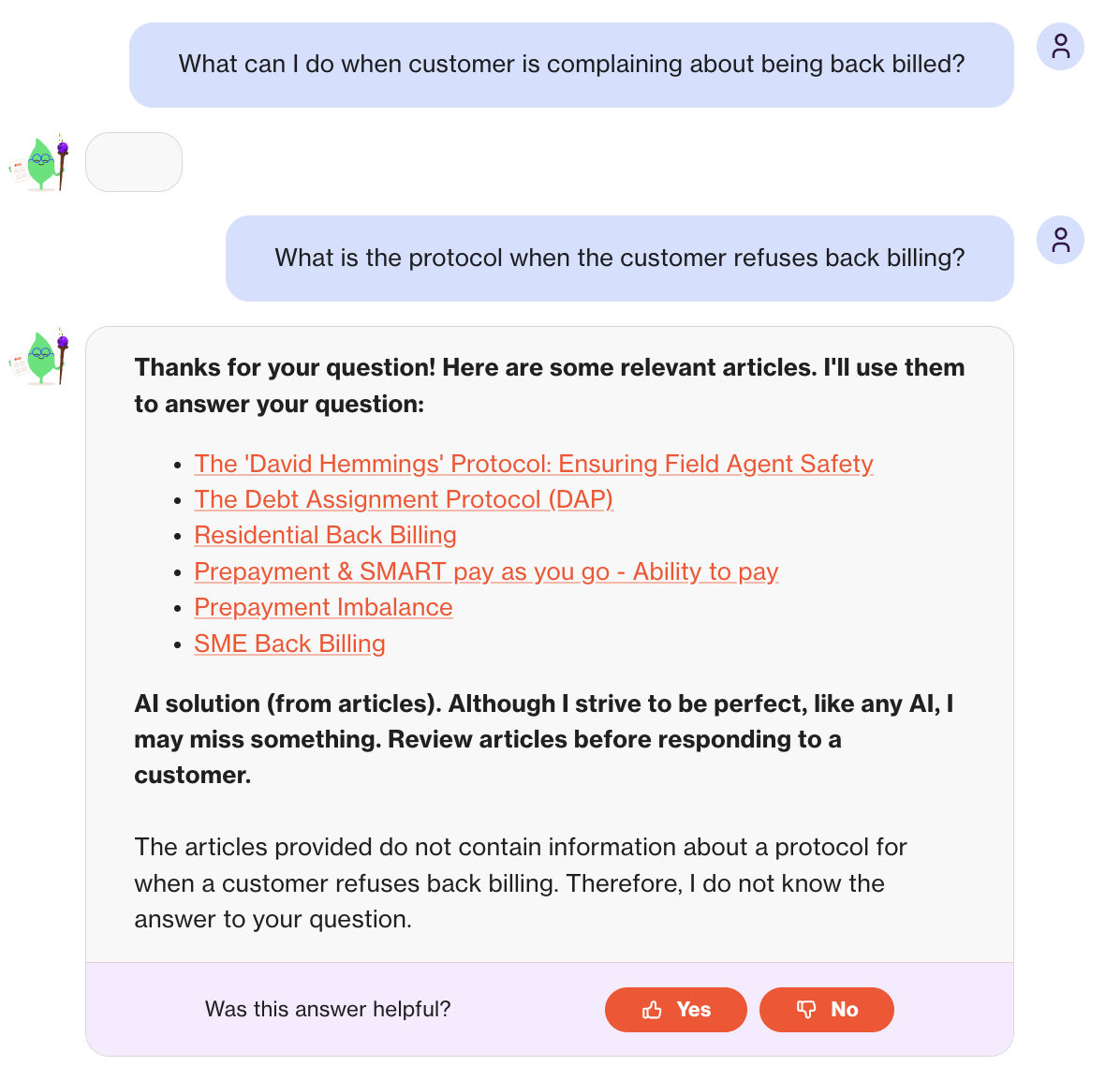
The earlier tools did not solve it. Wiki Whisperer V1, the first AI attempt, launched to excitement then quickly lost trust.
It returned too many dead ends and forced specialists to phrase prompts in exactly the right way.
Specialists fell back on the fastest thing they knew, asking a colleague.
My goal was to design a tool they would reach for first.
THE REDESIGN
building trust, usability and flexibility
principle #01
conversational partner
Multi-turn, natural dialogue replaced exact-phrase prompting, so agents can untangle complex, layered cases in real time.
principle #02
familiar by design
Built on E.ON Next's design system, the interface followed patterns agents already know from Gemini and ChatGPT, so V2 added no new mental model.
principle #03
structured and sourced
Long paragraphs became scannable sections, bullets and step-by-step guides, each linked to source articles so agents can trust what they read.
principle #04
creative on demand
Beyond answers, specialists can ask for tables, learning documents and more, using the Wiki in ways V1 never allowed.
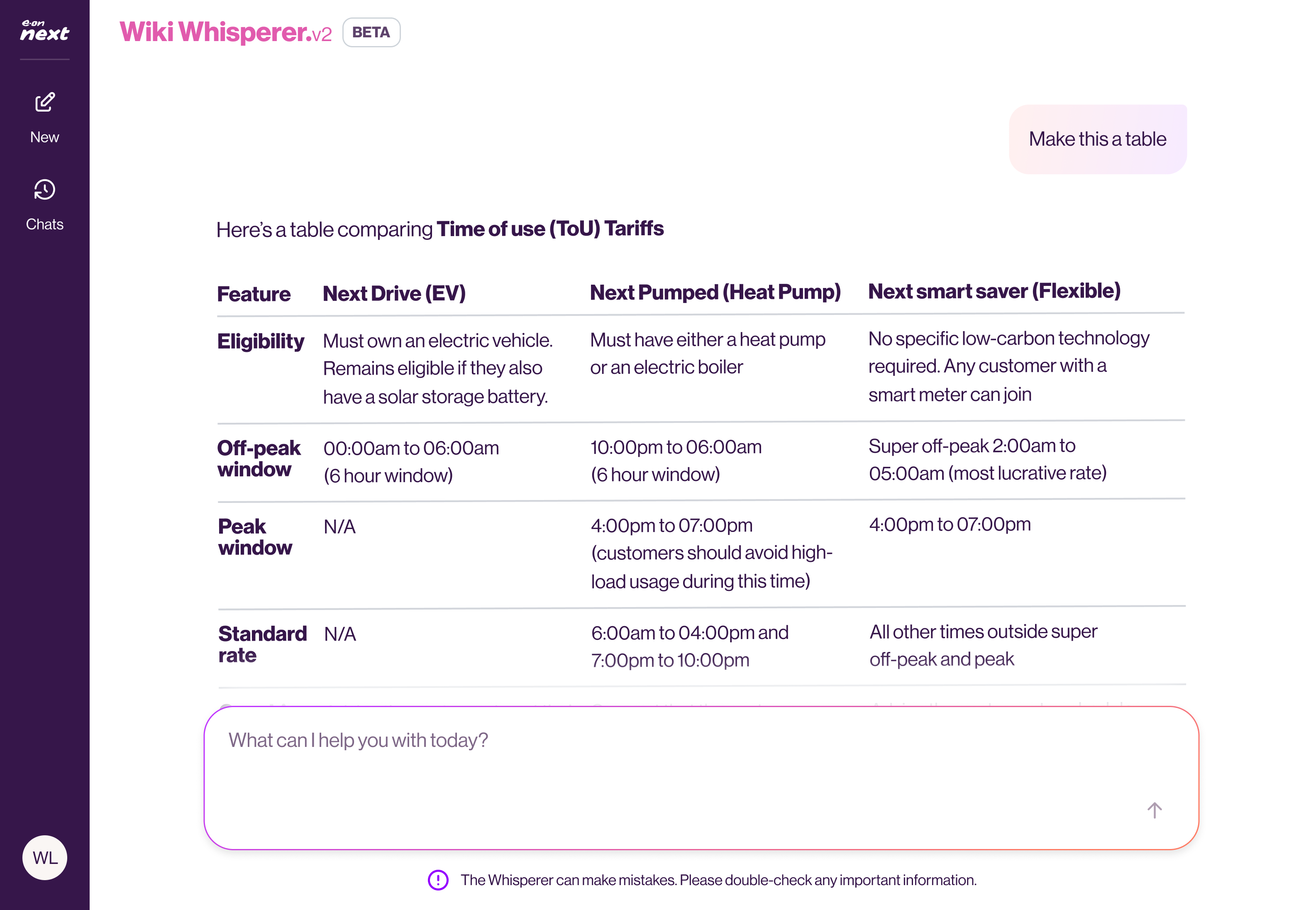
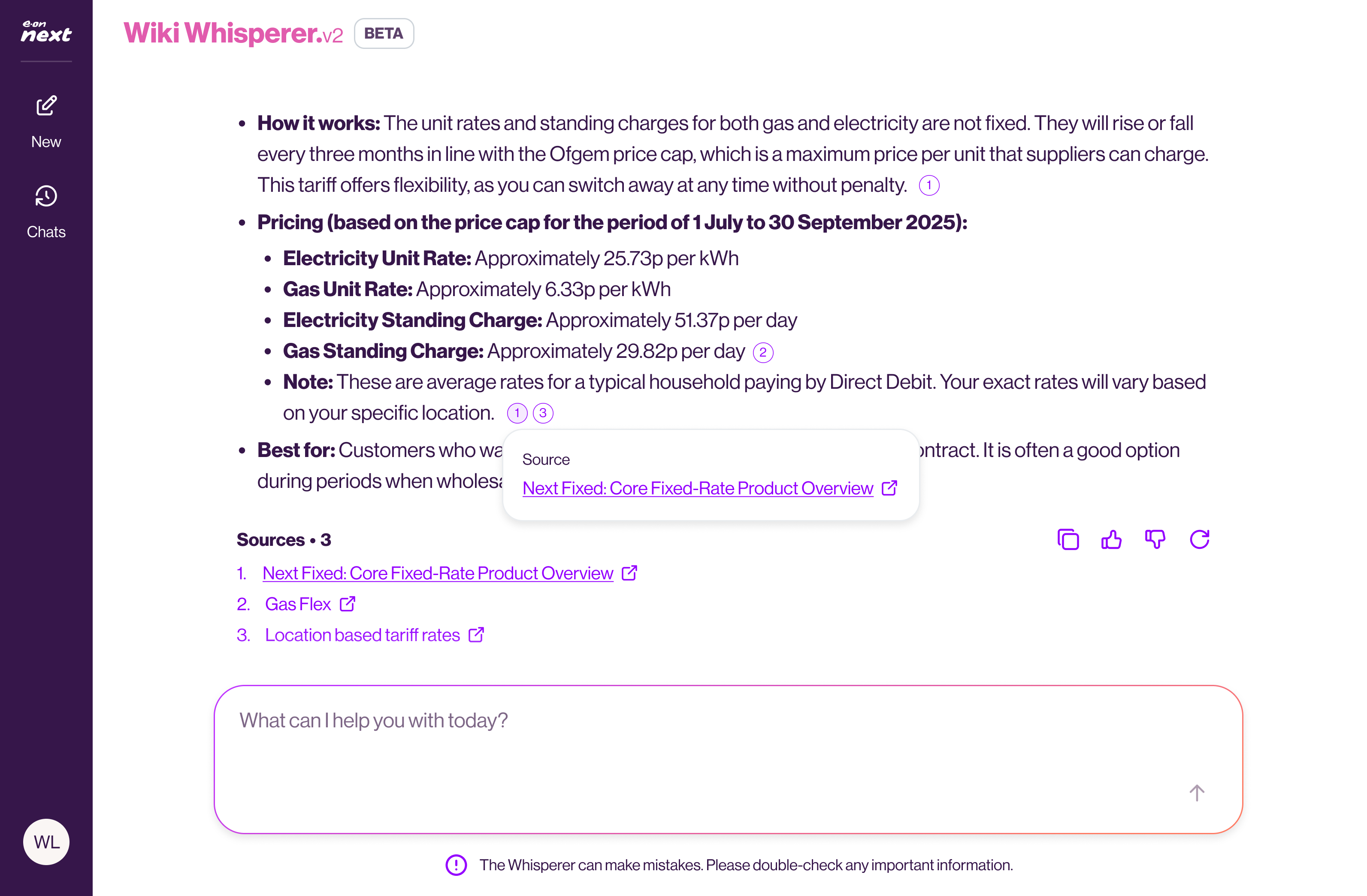
An answer is only useful if the specialist trusts it enough to say it out loud. So we designed for trust and reliability before anything else.
Under the hood
Production-grade,
eval-driven retrieval AI
V2 had to undo V1's scars, so answers were put through rigorous testing with subject-matter experts before release. Working alongside the AI platform and the Learning and Development ops team, we validated the agent against the real questions specialists face.
agentic #01
LLM · tools · LangGraph
One of E.ON Next's first autonomous agents: a reasoning-and-acting loop on LangGraph, where an LLM plans each step and calls retrieval tools.
grounded #02
RAG · guardrails
It answers only from E.ON Next's own knowledge, using RAG over a continuously resynced knowledge base, with guardrails that block anything off-limits.
proven #03
golden dataset · evals
Subject-matter experts validated answers against a golden dataset before release, and a chunking and retrieval rework lifted positive recall from 82% to 90%.
User pilots
Understanding the tool's
real effect
2
separate
user pilots
14
control and
variant teams
12
weeks of
testing
Our data scientist compared treatment teams against matched control teams to isolate the tool's effects while I led the qualitative side, interviewing specialists about their experiences.
User-led refinement
Energy specialists guiding
product’s improvement
The pilots surfaced a steady stream of refinements.
Some were quick usability wins that made V2 easier to live with on a call.
speed >
In the first weeks of the trial, agents were hindered by latency, so we've refactored the architecture to improve the speed.
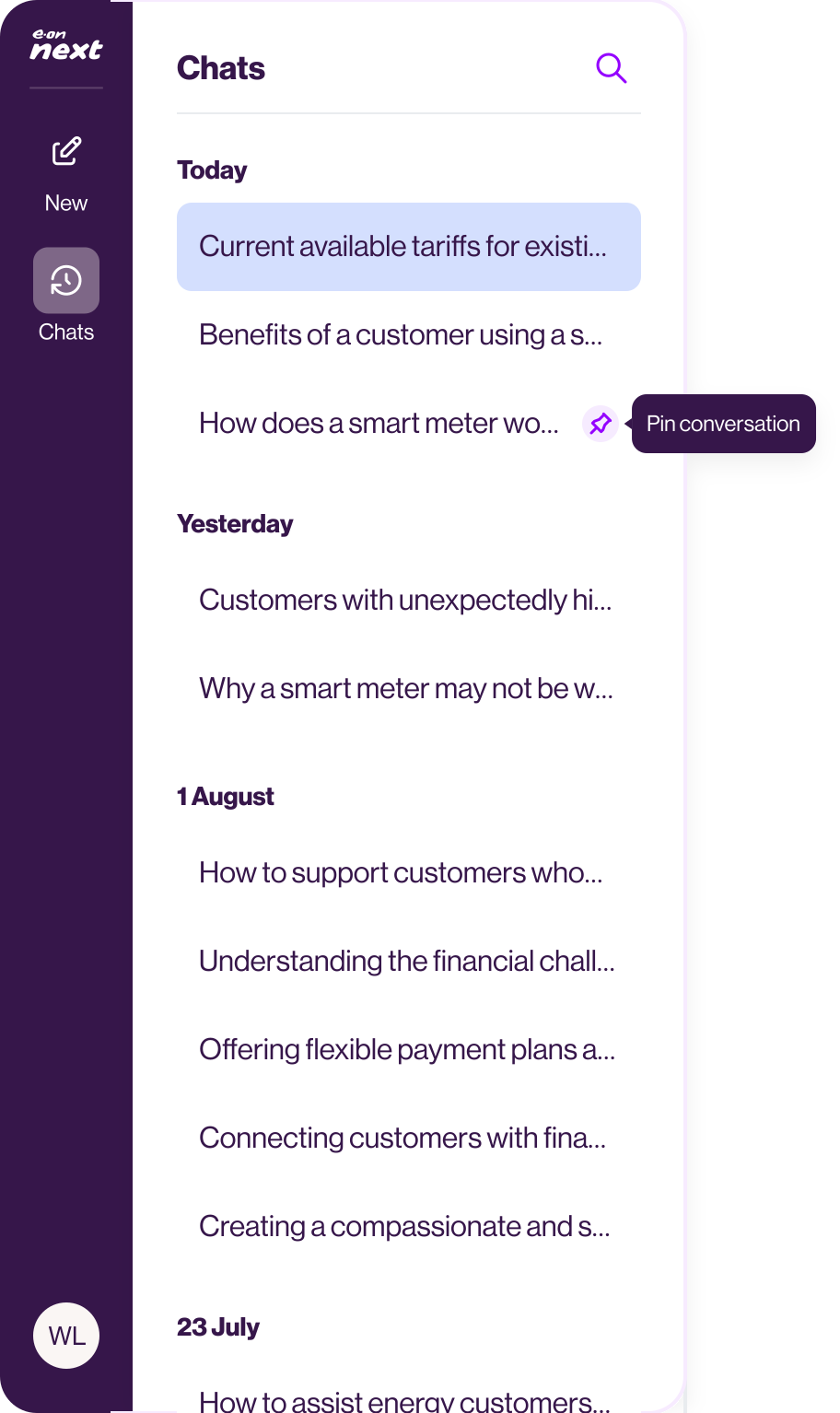
pin answers >
Energy specialists find there are a few things they continuously keep asking, now they are just one tap away.
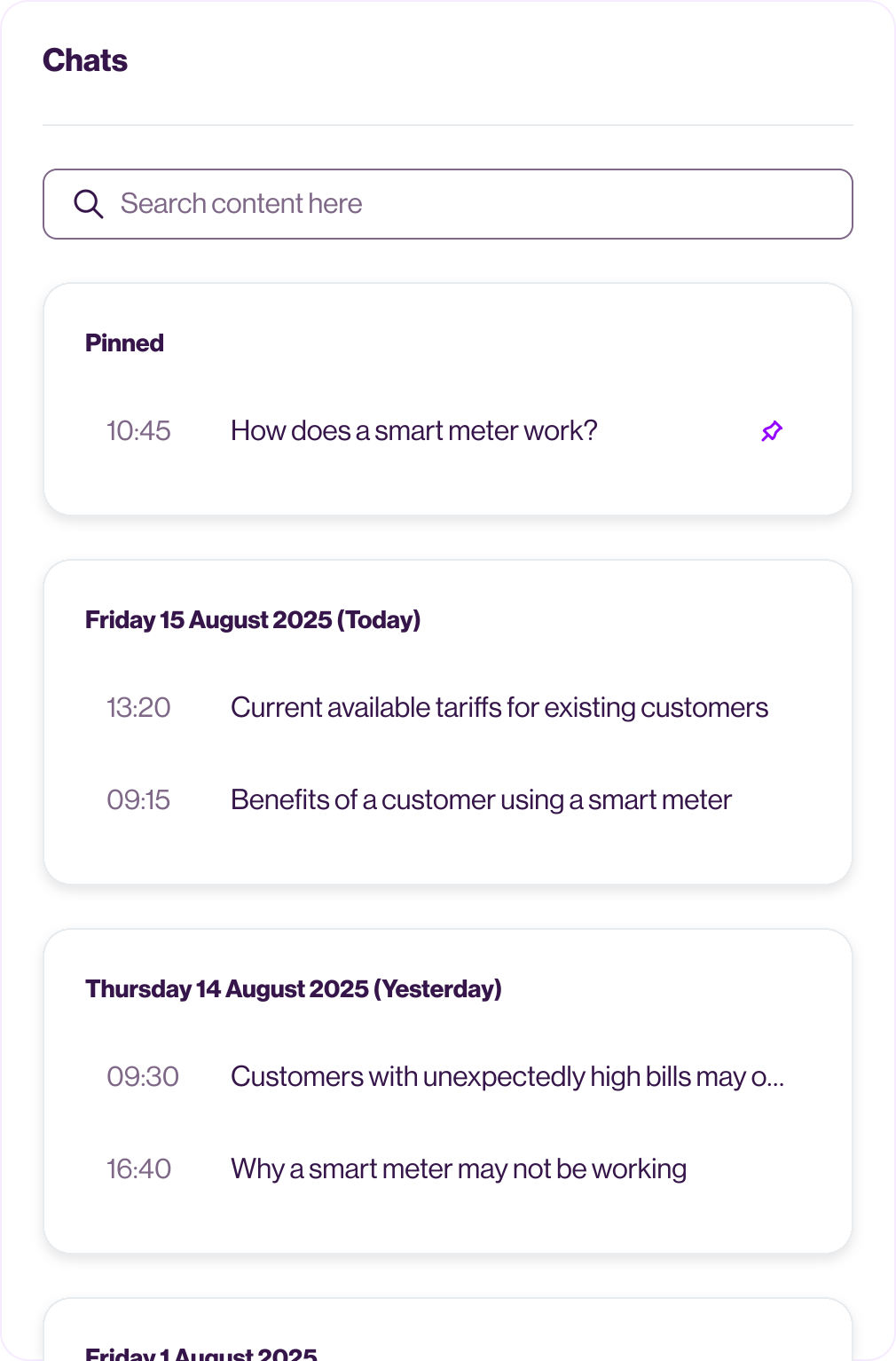
search history >
Past chats are searchable, so energy specialists can go back to the knowledge they've already found.
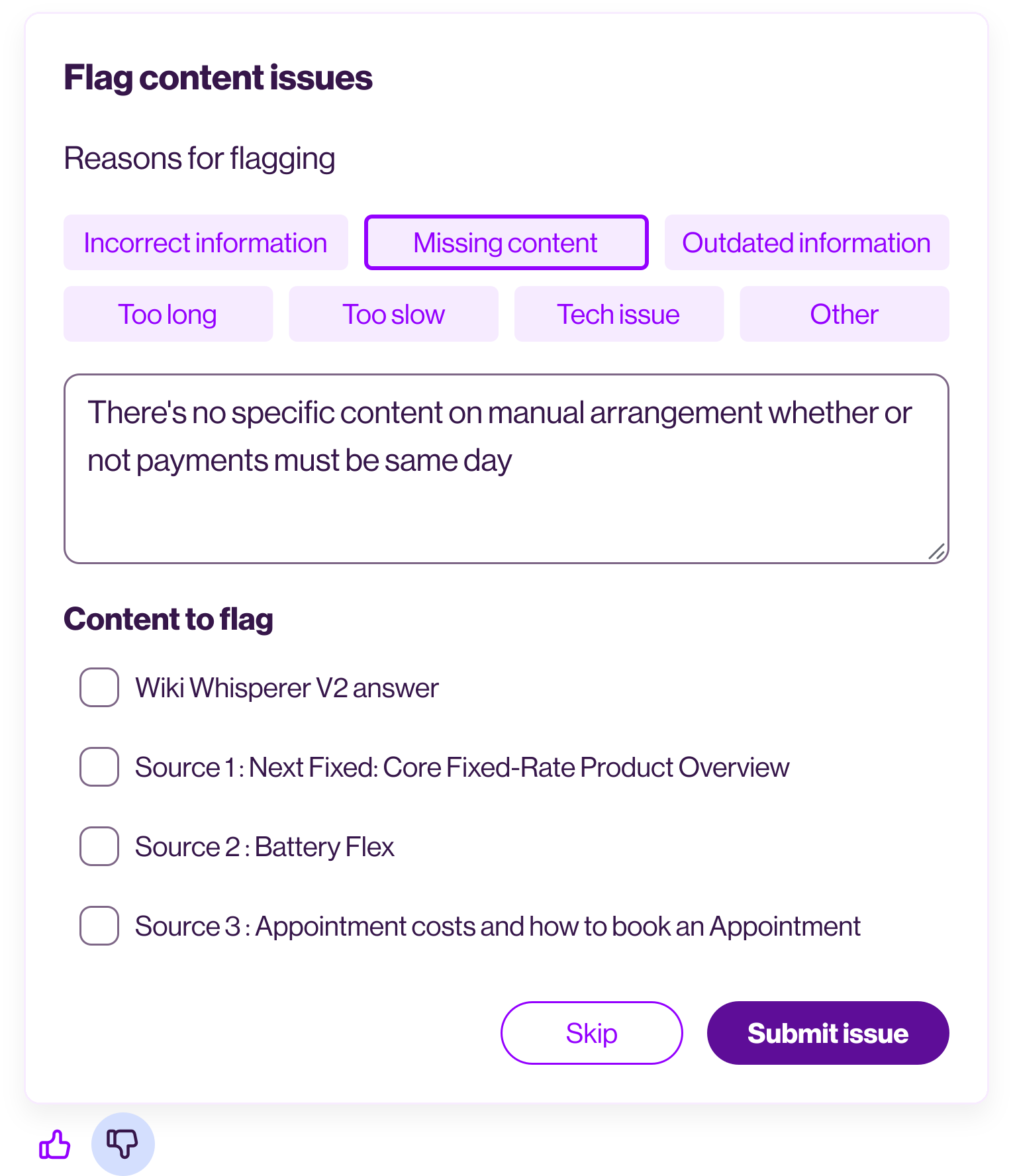
the flag form >
A thumbs-down opens a quick form, where agents say what was wrong and flag the specific source.
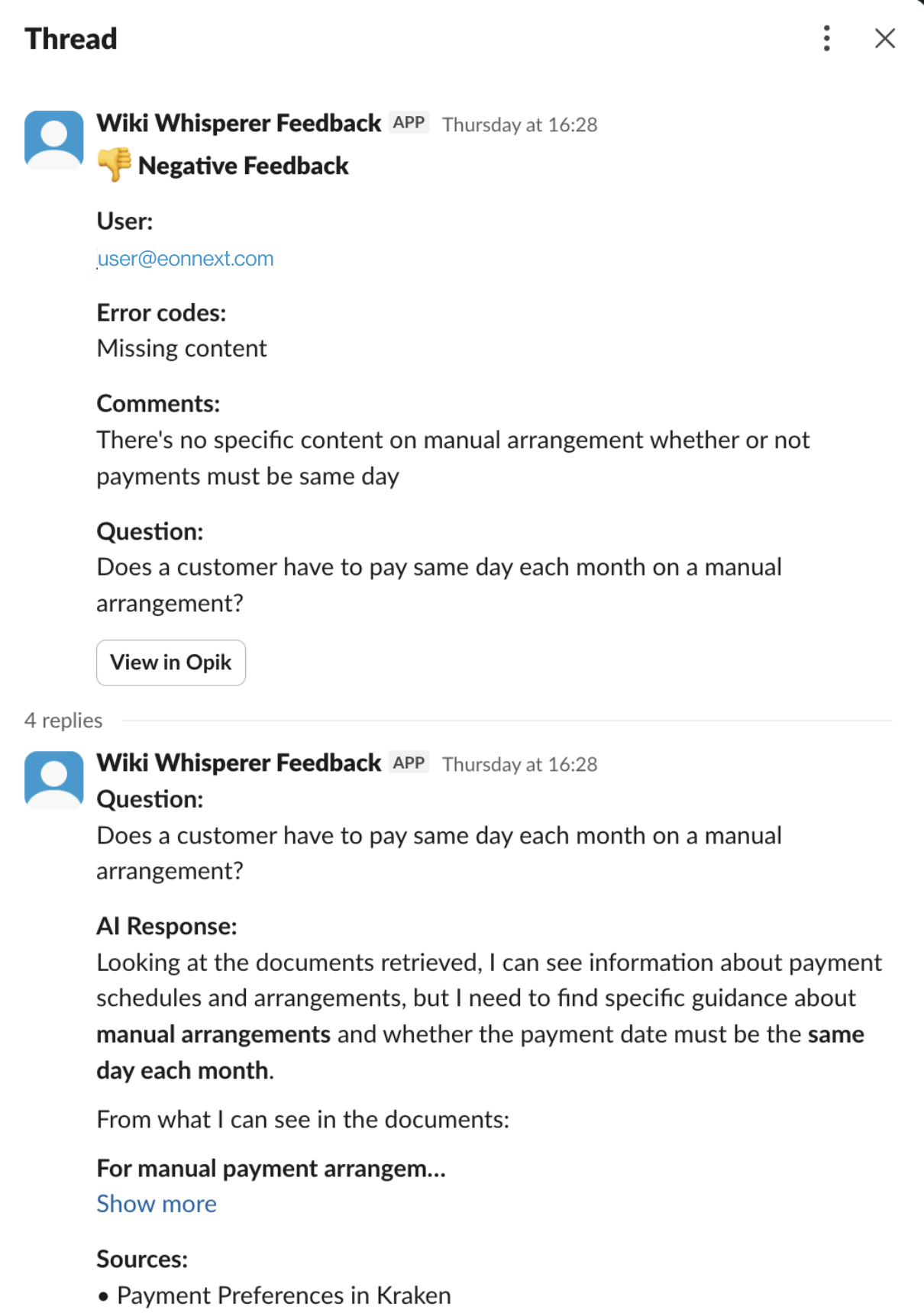
routed to be actioned >
Feedback routes for traceability and to a Slack channel where experts can pick it up and fix it fast.
Big wins
From scepticism to reliance
The clearest signal came from specialists themselves.
They had gone from doubting the tool to depending on it.

“I find it's a lot more streamlined and a lot more accurate. No matter what you type, you get good information.”
@Energy Specialist
“I can actually read step-by-step instead of reading a massive paragraph.”
@Energy Specialist
“It has information which most people in the office probably couldn't answer without asking someone in the field.”
@Energy SpecialistEarly impact
Signals worth scaling
Some teams closed their support channels a couple of weeks into the trial, leaning on the tool instead of each other.
89%
adoption across all trial teams
97%
would recommend V2 to other specialists
94%
said it helped prevent follow-up contacts
91%
now rely less on the old Wiki or Slack
In the new-starter academy >
V2 compressed the learning curve and reduced the number of senior advisors needed on the floor.
“Wiki Whisperer V2 has significantly enhanced our onboarding, empowering new starters with consistent information and noticeable improvements in confidence, knowledge retention and engagement.”
@Academy Skills LeadThe rollout
Showcasing Wiki Whisperer’s
new capabilities
The pilots surfaced one more thing. Some specialists were so burned by V1 that their expectations for V2 were low, they missed features or didn’t realise the tool was conversational until we spoke with them.
Adoption wasn’t just a product problem, it was also a perception one. So for the company-wide rollout, I led the creation of a one-minute feature-showcase video to reset that first impression.
What's next
Account specific information
and image support
Two larger improvements surfaced in research.
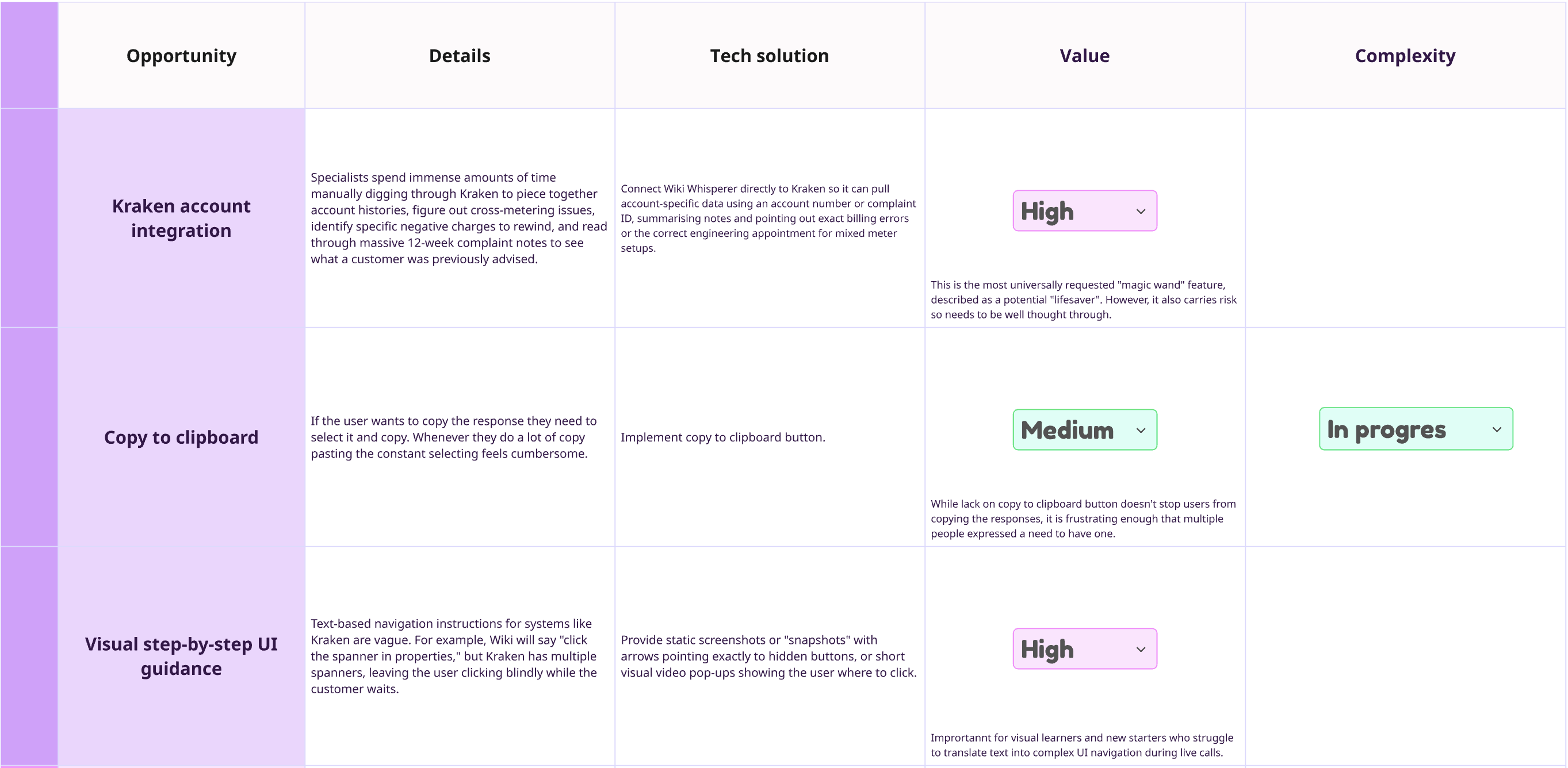
A CRM (Kraken) integration would connect Wiki Whisperer to customer data, pulling account-specific insights and resolving issues faster.
Energy specialists were also keen on images in responses. Particularly for questions about electricity meters, where a picture does a lot of the explaining.
View next project